Stories
My Sister Sold Our Grandmother’s Wedding Dress—Then the Buyer Asked Why My Name Was Sewn Inside It — Episode 1
I discovered my sister had sold our grandmother’s wedding dress three days before the family planned to display it at my cousin’s wedding. When I confronted her, she shrugged and said, “Grandma is gone. You need to stop treating old things like they belong to you.” My mother told me to let it go because my sister needed the money more than I did. But there was something neither of them knew. I had personally helped Grandma restore that dress, and she had hidden something inside its lining. Th...
Full story · Fiction
My sister was standing in our grandmother’s bedroom, holding an empty garment bag, when I realized she had sold the wedding dress we had promised to keep in the family.
The wooden wardrobe stood open. Its brass handle was scratched, and a small piece of white lace was still caught in the bottom hinge. The dress was gone.
“Where is Grandma’s dress?” I asked.
Melissa didn't turn around. She was checking something on her phone.
“Sold it.”
I thought I had misunderstood her.
“You did what?”
She slipped her phone into her jeans pocket. “A vintage clothing dealer bought it. He paid well.”
I looked at the empty hanger. Grandma Eleanor had worn that dress when she married Grandpa in 1968. It wasn't particularly expensive, but it had survived two house moves, three generations, and a flood that ruined almost everything else in her basement.
We had promised to display it at our cousin Hannah’s wedding the following weekend.
“You knew we were taking it to Hannah’s wedding.”
Melissa rolled her eyes. “Hannah can wear something else.”
I looked toward the hallway. Our mother, Diane, was standing there with a basket of folded laundry.
“Mom, did you know about this?”
She adjusted the towels in her arms.
“Your sister needed the money.”
“For what?”
Neither answered immediately.
Melissa finally said, “I have expenses. Not everyone has your comfortable little life.”
I worked as a medical billing coordinator. I wasn't wealthy. I simply paid my bills on time and didn't expect other people to solve my problems.
“What did you sell it for?”
“Three thousand dollars.”
I stared at her.
“That dress isn't yours to sell.”
Melissa laughed quietly.
“Grandma is dead, Claire. Stop acting like you're the only person who loved her.”
That sentence hurt more than I expected.
Because Melissa hadn't visited Grandma during the last six months of her life. I had driven forty minutes each way after work, helped her shower, prepared her meals, and sat beside her when she couldn't sleep.
I didn't do those things to earn anything.
But hearing my sister use Grandma's death to justify selling something she had treasured felt cruel.
“Who bought it?” I asked.
“A dealer named Robert. I already transferred the money.”
“Can I have his number?”
“No.”
My mother placed the laundry basket on a chair.
“Claire, please. Don't turn this into another family argument.”
I looked at her.
“Another argument? You both knew I was bringing that dress to the wedding.”
“Your sister made a decision,” Mom replied. “You don't have to agree with everything she does.”
I walked out before I said something I couldn't take back.
But I wasn't ready to let the dress disappear.
That evening, I called Hannah.
She was sitting in her apartment, surrounded by wedding decorations, when I told her what happened.
She went quiet.
“Claire, I thought Aunt Melissa told you Grandma gave her the dress.”
I sat down.
“What?”
Hannah explained that Melissa had already contacted her two weeks earlier. She claimed Grandma had promised her the dress before she died and that I was refusing to accept the decision.
Hannah had believed her.
“She even sent me a picture of a note,” Hannah said. “It had Grandma's handwriting.”
“Did you save it?”
“I think so. Let me check.”
A few seconds later, my phone vibrated.
The photograph showed a small piece of lined paper with three sentences written in blue ink.
The handwriting looked like Grandma's.
But something bothered me.
The note was dated November 14.
Grandma had died on November 9.
I enlarged the photograph.
“Did Melissa tell you when she received this?”
“No. She said Grandma left it with her things.”
I saved the photograph and called my mother again.
She didn't answer.
The following morning, I drove to the house where Grandma had lived. My mother was sorting her remaining belongings for donation. She had agreed to let me collect the family photographs and a few personal items.
I found her in the kitchen, wrapping plates in newspaper.
“Mom, I need to ask you something.”
She kept folding the paper.
“Is this about the dress again?”
I showed her the photograph.
“Why is this note dated five days after Grandma died?”
Her hands stopped moving.
For several seconds, she stared at the screen.
Then she placed the plate on the counter.
“Melissa told me she found it in Grandma's bedside drawer.”
“That doesn't answer my question.”
“Maybe she wrote the date incorrectly.”
“Mom, Grandma couldn't have written something five days after she died.”
My mother looked toward the kitchen window.
I asked the question I had been avoiding.
“Did you know Melissa was telling everyone Grandma had given her the dress?”
Mom didn't answer.
Instead, she said, “Your sister has been having a difficult year.”
I almost laughed.
“So you let her lie about Grandma?”
“I'm trying to keep this family together.”
That was when I noticed something underneath the newspaper on the counter.
It was a receipt from a tailor.
The date was October 3, nearly six weeks before Grandma died.
The description read: WEDDING GOWN RESTORATION — INTERNAL LINING REPLACEMENT.
I picked it up.
“Why did Grandma take the dress to a tailor?”
My mother took the receipt from my hand.
“She wanted it repaired.”
“I know. I drove her there.”
Mom looked at me.
I remembered that afternoon clearly. Grandma had complained about a loose section of lining near the waist. She had asked me to accompany her because she didn't trust the tailor to understand which parts of the original stitching mattered.
After the fitting, she had made me promise something.
“If anything happens to me, don't let anyone cut this dress apart just to make it fashionable.”
I had thought she was simply being sentimental.
Now I wondered why she had been so specific.
I took a photograph of the receipt.
My mother folded her arms.
“Claire, leave this alone. Your sister already sold it.”
“I'm going to contact the buyer.”
“You'll embarrass everyone.”
I looked at her.
“I'm more concerned about why you're protecting someone who lied about Grandma.”
She didn't follow me when I left.
That afternoon, I found the dealer's business through the name on a photograph Melissa had posted before deleting it. His shop was about twenty minutes away.
I called first.
A man answered.
“Vintage & Heirloom Restoration.”
“Hello. My name is Claire. I believe my sister recently sold you a wedding dress that belonged to my grandmother.”
There was a pause.
“Are you Eleanor's granddaughter?”
“Yes.”
His voice changed.
“I'm glad you called. I've been trying to find you.”
I gripped the phone.
“Why?”
“I purchased the dress from your sister. But when I inspected the lining, I found something unusual.”
“What did you find?”
He hesitated.
“There's an envelope sewn inside the original lining. It has your name written on it.”
I couldn't speak.
“Has anyone opened it?”
“No. I thought it might be a family document, so I stopped working on the dress.”
I asked him to hold it until I could come in.
Then I called Melissa.
She answered on the fourth ring.
“What now?”
“Did you know there was an envelope inside Grandma's dress?”
Silence.
Then she said, “What envelope?”
I told her the buyer had found something with my name on it.
Her voice became sharp.
“Claire, don't touch anything. That dress belongs to me now.”
“You sold it.”
“I can buy it back.”
“Why would you need to buy it back if there's nothing inside?”
She hung up.
I stood in my apartment for a long time, staring at the phone.
Something about her reaction frightened me more than the sale itself.
The next morning, I visited the shop.
Robert was a man in his late fifties with silver hair and reading glasses hanging from his shirt. He led me into a small restoration room.
The dress lay across a padded table.
For the first time in months, I saw it again.
The delicate ivory fabric. The tiny pearl buttons. The lace Grandma had carefully preserved.
Robert pointed to a section near the waist.
“Your grandmother had this lining reinforced. Whoever repaired it did very careful work.”
He showed me a small envelope tucked beneath the fabric.
My name was written across it in Grandma's handwriting.
I recognized the way she crossed the letter T.
My eyes filled before I even touched it.
Robert asked whether I wanted him to remove it.
I nodded.
Inside was a folded letter and a small brass key attached to a paper tag.
The letter began with three words.
My dearest Claire.
I read the first paragraph twice.
Grandma wrote that she had hidden something because she knew certain people in the family would try to take it before she had the chance to explain.
She mentioned the dress, the tailor, and a conversation she had overheard in her own kitchen.
Then I reached the final paragraph.
It said that the key opened a small deposit box at the local credit union, and that I should visit alone before discussing its contents with anyone.
I looked at the brass key.
Robert turned the paper tag over.
There was a handwritten number on the back.
Before I could ask anything else, my phone started vibrating.
Melissa.
I declined the call.
It rang again.
Then a message appeared.
“Claire, please don't go to the bank. Mom is going to explain everything. Grandma didn't want you to know.”
I read it again.
Grandma didn't want me to know.
But she had sewn my name into the dress and hidden a key where my sister would never think to look.
I placed the letter carefully inside my bag.
Robert watched me.
“There's one more thing,” he said.
I turned around.
He opened the photograph he had taken when he first inspected the dress.
“Your sister brought someone with her when she sold it. I didn't think it mattered at the time.”
He enlarged the image.
A reflection in the shop window showed Melissa standing beside a woman holding a brown document folder.
I recognized the woman's coat immediately.
It belonged to my mother.
But that wasn't what made my hands stop moving.
The folder had the same credit union logo printed on it as the paper tag attached to Grandma's key.
And beneath the photograph, Robert had written the name of the person who had asked him whether the envelope could be removed before the dress was sold.
It wasn't Melissa.
It was my mother.
I looked at him.
“Did you tell them you found the envelope?”
Robert shook his head.
“No. But someone called this morning asking whether you'd come to collect it.”
“Who?”
He turned his computer toward me.
The caller had left a message.
I pressed play.
My mother's voice came through the speaker.
“Please tell Claire not to open that box. Her grandmother put something in there that could tear this family apart.”
Take a break. Sharpen your mind.
Trivia, word games, puzzles and more—fresh challenges are waiting every day.
Explore all gamesRelated Articles
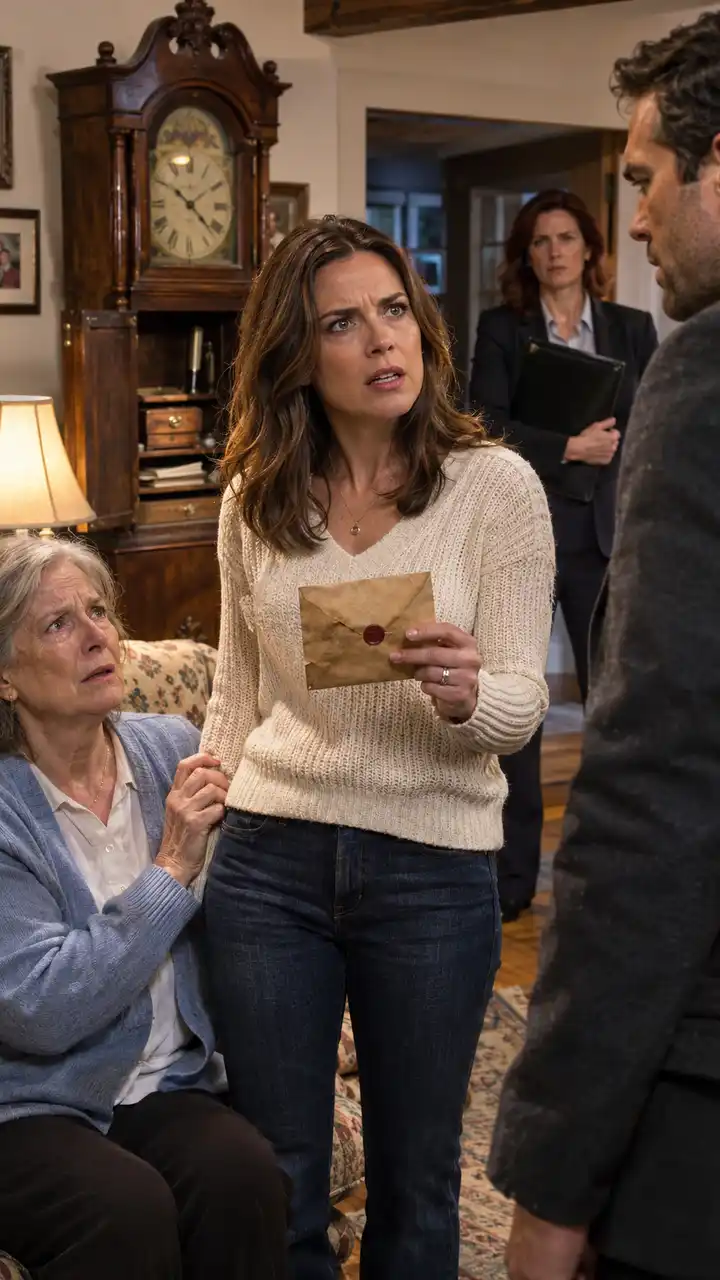
My Brother Sold Our Mother's House While She Was Still Alive — But He Didn't Know What She Had Hidden Inside the Walls — Episode 1
My brother sold our mother's house for $485,000 while she was still alive, and he didn't even bother telling her. I discovered the sale when a moving company arrived at her front door and started carrying away the furniture she'd spent forty years collecting. When I confronted him, he calmly explained that Mom had signed everything and that I had no right to interfere. But something didn't make sense. Mom couldn't remember what she'd eaten that morning, yet my brother claimed she had willingl...
My Brother Sold Our Mother's House While She Was Still Alive — Episode 4: The Meeting That Destroyed My Brother's Last Defense — Episode 4
My brother thought he could silence everyone by claiming our father had personally given Grant Mercer control of the family's $640,000 secret account. But when Grant walked into the lawyer's office carrying a supposedly signed document, my father's attorney recognized something that made him turn pale. The signature was real, but the date wasn't. Then Vanessa revealed the emails she'd secretly recovered from Daniel's computer. For the first time, my brother had nowhere left to hide. But just...
My Sister Told Everyone I Abandoned Our Father — Then I Found the 47 Letters She Never Let Him Read — Episode 1
My sister stood beside our father's hospital bed and told everyone I hadn't visited him in eleven months. She even showed our relatives a calendar proving I had forgotten his birthday, Thanksgiving, and Christmas. My father looked at me with tears in his eyes and whispered, "I thought you didn't love me anymore." I couldn't explain myself because I had no idea what she was talking about. Then a nurse handed me a dusty cardboard box she'd found in my father's locked desk. Inside were 47 unopen...
Recommended for You
My Sister Told Everyone I Abandoned Our Father — Then I Found the 47 Letters She Never Let Him Read | Episode 5: The Truth That Finally Brought Us Home — Episode 5
My sister had spent eleven months keeping my letters from our father, but the biggest betrayal was still waiting. An amendment bearing Dad's forged signature had transferred control of our family inheritance, and my biological mother had apparently signed it too. Then we discovered Vanessa had secretly contacted Laura eleven months earlier. The two women had made an arrangement neither Dad nor I knew about. When Laura finally walked into the room, she was carrying something that changed every...
My Sister Told Everyone I Abandoned Our Father — Then I Found the 47 Letters She Never Let Him Read | Episode 4: The Promise Mom Made Me Break — Episode 4
My sister finally admitted that our biological mother had returned when I was six years old. But the truth was worse than I imagined. My mother Margaret hadn't simply rejected her younger sister. She had made a secret arrangement that kept Laura away from me for decades. Then Vanessa confessed that she had personally helped destroy Laura's attempts to contact us. I thought that was the worst betrayal. Until my attorney discovered that someone had been quietly withdrawing money from a family t...
My Sister Told Everyone I Abandoned Our Father — Then I Found the 47 Letters She Never Let Him Read | Episode 3: The Mother I Never Knew — Episode 3
I spent 42 years believing Margaret Mitchell was the woman who gave birth to me. Then an anonymous email showed me a hospital record with another woman's name. My sister Vanessa knew something about it, and my father had apparently spent his entire life protecting the secret. But the biggest shock came when I finally played the USB recording hidden beneath my father's letters. My mother's voice filled the room. What she said explained why my sister had been so desperate to keep me away. And t...
Join the discussion
No comments yet. Start the conversation.